Absolutely. I have used the material you provided as the source and built the description around the actual plot, characters, setting, conflict, and themes in the text. I have kept the writing original rather than copying the wording of the source. The source identifies the novel as MURADIN ZUCI by Bintu Musa, and establishes its central conflict around Fadwa, her abandonment, and the family that unexpectedly becomes connected to her fate.
One important point: I can write it from scratch to avoid intentional copying, but no honest writer or AI can mathematically certify "zero percent plagiarism" against every piece of writing on the internet without running it through a plagiarism database. The text below is newly written from your supplied material.
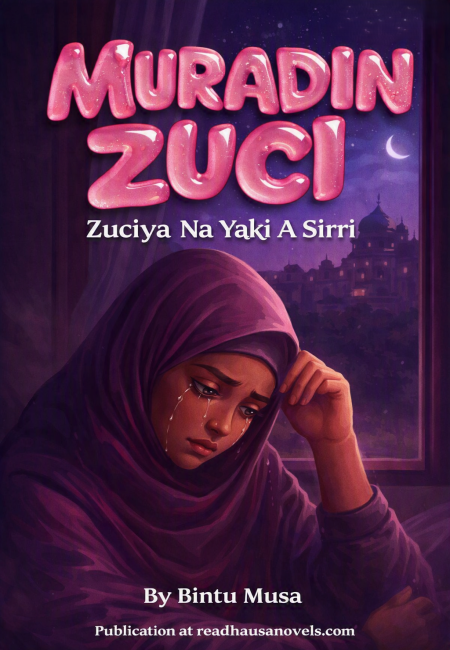
MURADIN ZUCI by Bintu Musa
A Hook That Pulls You In
What happens when a helpless baby is abandoned at the doorstep of a wealthy family, only for her arrival to expose wounds, secrets, resentment, and a bond nobody expected?
On a cold night in Houston, a young woman drives through a wealthy neighborhood with tears in her eyes and a newborn baby hidden beside her. She knows exactly what she is about to do, yet every step toward the gate feels like a battle against her own heart. She leaves the baby behind and drives away, but before she can find the courage to return, the door to the baby's new fate has already opened.
The child is Fadwa.
Her arrival will change more than one life.
Summary
Muradin Zuci opens with a heartbreaking mystery surrounding a newborn baby who is abandoned outside the home of a wealthy family in Houston. The woman who leaves her there appears to have everything needed to care for the child, yet something has pushed her into making an unbearable decision. She leaves Fadwa in a basket, hoping that someone will find her, while fighting the urge to turn back. Her final departure immediately raises one of the novel's biggest questions: why would a woman abandon a child who appears to have come from a comfortable background?
Fadwa is discovered by a man known as Papa and his twin sons, Imam and Imran. Instead of ignoring the helpless child, Papa takes her inside despite knowing that her presence could create serious complications for his family. His compassion quickly becomes stronger than his fear of the consequences. Even before knowing where Fadwa came from, he sees an innocent child who has been given no choice in what has happened to her. The twins also become emotionally attached to her, particularly as they begin to see her as someone who needs their protection.
Not everyone in the household welcomes Fadwa. Papa's pregnant wife, Fatima, strongly objects to keeping the abandoned baby. Her fear is not simply about responsibility. She worries about the unknown circumstances surrounding the child and believes that accepting her into the family could bring unwanted trouble and damage their reputation. Her resistance creates a serious disagreement between husband and wife, revealing that the arrival of Fadwa is beginning to test the strength of a marriage that already has unresolved tensions.
The situation becomes even more complicated when Fatima contacts the authorities. Child services and the police become involved, and Papa is forced to confront the reality that compassion alone may not be enough to keep Fadwa. The authorities investigate the circumstances of her abandonment, including the mysterious vehicle used by the woman who left her. Yet the investigation produces more questions than answers, because the vehicle cannot be properly traced and the woman does not appear to have come from the desperate circumstances one might expect.
Instead of simply allowing Fadwa to disappear into the child welfare system, Papa begins considering adoption. His attachment to the child has grown into something deeper, and he becomes determined to give her a permanent home. But there is another obstacle. The adoption process requires the consent of both spouses, placing Fatima in a position where she must decide whether to continue resisting the child or finally acknowledge the place Fadwa has already begun to occupy within the family. Eventually, Papa takes the matter into the legal system and fights for the right to make Fadwa his daughter. The court ultimately grants his wish, marking a major turning point in Fadwa's life.
About the Novel
Muradin Zuci is a Hausa contemporary family drama built around emotional conflict, mystery, fate, compassion, marriage, motherhood, and the unexpected relationships that can grow from painful circumstances.
Although the story contains elements of romance and family relationships, its strongest foundation is the emotional and moral dilemma created by Fadwa's abandonment. The novel asks readers to consider whether blood alone determines family, whether compassion can overcome fear, and whether a person's destiny can become permanently connected to someone else's simply because of one unexpected event.
The story also explores the consequences of decisions made under pressure. The woman who abandons Fadwa believes she has reached the end of her options, while Papa sees the same situation from an entirely different perspective. Fatima, meanwhile, sees danger where Papa sees an opportunity to save an innocent life. These opposing viewpoints create much of the novel's emotional tension.
Genre
Muradin Zuci falls primarily within the Hausa family drama and emotional fiction category, with strong elements of mystery, relationship drama, romance, social issues, and suspense.
The novel is particularly suited to readers who enjoy stories where family relationships are tested by unexpected circumstances. Rather than relying on a single conflict, the narrative gradually builds several connected problems around Fadwa's arrival. Her abandonment creates a chain reaction that affects marriage, children, family reputation, legal responsibility, and questions about identity.
Setting
A major portion of the opening story takes place in Houston, United States, where the novel immediately establishes a cold nighttime atmosphere surrounding Fadwa's abandonment. The wealthy neighborhood, large family home, American social environment, police involvement, child protective services, and adoption procedures give the story a distinctly Nigerian family experience within an American setting.
The story also carries a strong connection to Nigeria through the characters' background, family identity, culture, social expectations, and references to their wider family and homeland. This creates an interesting contrast between the American environment in which much of the action takes place and the cultural values that continue to influence the characters' decisions.
The setting therefore becomes more than a location. Houston represents the environment in which Fadwa's mystery unfolds, while the characters' Nigerian roots shape how they understand family, reputation, responsibility, faith, and social expectations.
The Core Themes
Fate and Destiny
Fate is one of the most important ideas behind Muradin Zuci. Fadwa does not choose where she is born, who abandons her, or the family into which she eventually enters. Yet one seemingly random act changes the direction of several lives.
The novel repeatedly asks whether some encounters are simply coincidences or whether they are part of a larger destiny.
Family Beyond Blood
Fadwa's situation challenges the traditional idea that family is determined entirely by biological connection. Papa has no blood relationship with the child when he first discovers her, yet his concern for her rapidly develops into genuine parental affection.
The story therefore examines what it truly means to become someone's parent.
Compassion Versus Fear
Papa and Fatima respond to Fadwa's arrival in completely different ways. Papa focuses on the child's innocence and vulnerability, while Fatima focuses on the possible consequences of bringing a stranger's baby into their household.
Neither perspective is presented as a simple matter of right and wrong. Their disagreement forces readers to consider what they themselves might do if placed in the same situation.
Marriage and Misunderstanding
The arrival of Fadwa exposes problems within Papa and Fatima's marriage. Their disagreement over the baby becomes a much deeper argument about trust, respect, authority, reputation, and how far a husband or wife should go when they believe they are doing what is right.
The novel's emotional conflict therefore extends beyond Fadwa. Her presence becomes a test of the relationship between two adults who already struggle to understand one another.
Identity and Hidden Origins
Fadwa arrives with almost no explanation. Her clothing and belongings suggest that she did not come from extreme poverty, while the vehicle used by the woman who abandoned her raises even more questions. Even her name is discovered through the engraving on her towel.
This creates an underlying mystery that encourages readers to keep asking: Who is Fadwa, where did she come from, and why was she abandoned?
Faith, Responsibility and Mercy
Papa's decisions are strongly influenced by his understanding of religious responsibility and compassion. He sees helping an abandoned child as more than a personal choice. To him, it is also a moral responsibility.
This gives the story a spiritual dimension without removing the human conflict surrounding the situation.
Key Characters
Fadwa
Fadwa is the emotional center of the story. She enters the novel as a newborn who has already experienced one of life's cruelest forms of rejection, abandonment.
Although she is too young to understand what has happened, her presence becomes powerful enough to change the lives of everyone around her. Her vulnerability brings out Papa's protective instincts, the twins' affection, Fatima's fear, and the authorities' sense of responsibility.
Fadwa's greatest mystery is also her greatest narrative strength. She has an identity, a name, a history, and a past that the reader knows almost nothing about.
Papa
Papa is one of the novel's strongest emotional figures. His first major decision is simple but significant: he refuses to leave an innocent newborn outside in the cold.
His compassion for Fadwa gradually develops into a determination to protect her. Even when the practical and legal complications become overwhelming, he continues looking for a way to give her security.
His struggle is not only against the authorities or the circumstances surrounding Fadwa. He must also navigate the opposition of his own wife while trying to preserve his family.
Fatima
Fatima is one of the most complicated figures in the story because her position creates much of the domestic conflict.
She strongly rejects the idea of raising Fadwa, fearing the unknown circumstances surrounding the child and the possible effect on her family. Her behavior toward Fadwa and the disagreements with her husband make her a major source of tension.
At the same time, her character raises important questions about fear, social reputation, motherhood, insecurity, and the pressure of protecting one's family.
Imam
Imam is one of Papa's twin sons. He appears quieter and more observant than his brother, and his interest in Fadwa becomes noticeable from the moment she enters the family.
His concern for the baby gives the story another innocent perspective. Through the children, readers see Fadwa not as a social problem or legal case, but simply as a baby who needs someone to care for her.
Imran
Imran, Imam's twin brother, is more openly expressive about his attachment to Fadwa. His immediate desire to keep the baby adds warmth to the otherwise tense situation.
His reactions help demonstrate how naturally children can respond to vulnerability. Where adults see complications, Imran sees a baby who needs a family.
Habiba
Habiba is Fatima's attendant and an important supporting character within the household. She finds herself caught between the conflicting demands of Fatima and Papa.
Her position becomes difficult because she is expected to obey her employer while also caring for Fadwa. Through Habiba, the novel shows how domestic conflicts can affect people who are not directly responsible for the original disagreement.
Ladan
Ladan is Papa's close friend and someone he turns to when he needs advice. His role is important because he provides an outside perspective on the complicated situation surrounding Fadwa.
Unlike Papa, Ladan approaches the matter from a more practical and legal standpoint, encouraging him to consider child services and the realities of the American system.
Analytics and Story Insight
The strongest feature of Muradin Zuci is its use of a single unexpected event to create several layers of conflict.
The abandonment of Fadwa is not treated as an isolated incident. It becomes the beginning of a chain reaction. One decision affects a marriage. The marriage conflict affects the children. The children develop an attachment to Fadwa. The authorities become involved. Papa is forced to make legal decisions. Behind all of this remains the unanswered question of the baby's true origin.
This structure gives the story strong suspense because readers are not only waiting to discover what will happen to Fadwa. They are also waiting to understand why she was abandoned in the first place.
Another interesting aspect is the contrast between Papa and Fatima. Papa's emotional response is based largely on compassion, while Fatima's response is shaped by fear and self-protection. Their disagreement gives readers two completely different interpretations of the same event.
The novel also uses Fadwa as a catalyst. She barely does anything herself because she is a newborn, yet she becomes the reason other characters reveal parts of themselves that might otherwise remain hidden. Papa's compassion becomes clearer. Fatima's fears become visible. The twins reveal their innocence and affection. Habiba becomes caught between opposing loyalties.
This makes Fadwa more than a character. She becomes the force that exposes the emotional structure of the entire household.
The Suspense Behind Fadwa's Identity
One of the biggest reasons to continue reading Muradin Zuci is the mystery surrounding Fadwa's origins.
The woman who abandons her does not appear to be struggling financially. She arrives in a respectable vehicle, the baby is dressed well, and the circumstances surrounding the abandonment do not immediately provide a clear explanation. The vehicle itself cannot be properly traced by the authorities.
These details make the abandonment suspicious rather than straightforward.
Was Fadwa abandoned because her mother had no choice?
Was someone trying to protect her?
Was the baby being hidden from someone?
Or is there a deeper family secret waiting to surface?
The opening chapters do not give readers easy answers. Instead, they create questions that make Fadwa's future inseparable from the mystery of her past.
A Quote That Captures the Novel
"Shin soyayyar da aka rayu da ita acikin zuciya takan iya boyuwa?"
This question captures the emotional heart of Muradin Zuci. The novel is interested in feelings that people attempt to suppress, relationships that refuse to disappear, and connections that become stronger despite circumstances designed to keep people apart.
What Makes Muradin Zuci Worth Reading?
Muradin Zuci is not simply a story about an abandoned baby.
It is a story about what happens when one helpless child enters a household carrying a mystery nobody understands.
It is about a man who sees an innocent life in need of protection, a woman who fears the consequences of accepting a stranger into her family, and children who respond to the situation with a simplicity that adults have lost.
It is also a story about choices. Papa must decide how far he is willing to go for a child who is not biologically his. Fatima must face the consequences of the choices she makes. And somewhere beyond the family's immediate conflict, the woman who left Fadwa behind remains connected to the mystery that started everything.
For readers who enjoy Hausa novels filled with emotional family drama, complicated relationships, suspense, mystery, cultural values, and unexpected turns, Muradin Zuci offers a story built around one powerful question:
What if the person you never expected to enter your life was actually the person fate had chosen to change it forever?
Final Reader's Takeaway
At its heart, Muradin Zuci explores the thin line between destiny and choice. Fadwa is abandoned by one person but discovered by another. A stranger becomes a daughter. A disagreement between husband and wife becomes a battle over what family truly means. And a mystery surrounding one newborn child begins to uncover emotions that the characters may have spent years trying to hide.
The novel's greatest strength is the way it turns an apparently simple event into a much larger emotional journey. The baby left outside a house is only the beginning. What follows is a story of compassion, conflict, identity, responsibility, family, and the consequences of decisions made when the heart and the mind want completely different things.
Muradin Zuci by Bintu Musa is ultimately a story about the connections people cannot always explain, the love they cannot always control, and the destiny that sometimes arrives at the doorstep when nobody is prepared for it.


![<? $row['name']; ?>](https://readhausanovels.com/Public/thumb/225x325/ebook/2026/04/auto-76-rayuwa-da-gi-i-complete-hausa-novel-352955a393.webp)
![<? $row['name']; ?>](https://readhausanovels.com/Public/thumb/225x325/ebook/2026/04/auto-78-karuwan-cikin-gida-book-2-complete-hau-fb4ccbf490.webp)
![<? $row['name']; ?>](https://readhausanovels.com/Public/thumb/225x325/ebook/2026/04/auto-79-ar-goggo-complete-hausa-novel-bf34111897.webp)
![<? $row['name']; ?>](https://readhausanovels.com/Public/thumb/225x325/ebook/2026/04/auto-82-rayuwar-mace-complete-hausa-novel-c9b8534b3b.webp)
![<? $row['name']; ?>](https://readhausanovels.com/Public/thumb/225x325/ebook/2026/04/auto-83-rana-daya-book-1-complete-hausa-novel-9c9d9d0e65.webp)
![<? $row['name']; ?>](https://readhausanovels.com/Public/thumb/225x325/ebook/2026/04/auto-91-kida-a-ruwa-3-complete-hausa-novel-5acb79b03a.webp)
![<? $row['name']; ?>](https://readhausanovels.com/Public/thumb/225x325/ebook/2026/04/auto-93-rainon-soja-book-1-complete-hausa-nove-79a103512e.webp)
![<? $row['name']; ?>](https://readhausanovels.com/Public/thumb/225x325/ebook/2026/04/auto-95-abunda-ke-boye-complete-hausa-novel-3283cf6583.webp)
![<? $row['name']; ?>](https://readhausanovels.com/Public/thumb/225x325/ebook/2026/04/auto-96-ranar-naka-complt-complete-hausa-novel-873583e9cc.webp)
![<? $row['name']; ?>](https://readhausanovels.com/Public/thumb/225x325/ebook/2026/04/auto-97-cutarwa-complt-complete-hausa-novel-106ea9219f.webp)
![<? $row['name']; ?>](https://readhausanovels.com/Public/thumb/225x325/ebook/2026/04/auto-98-babu-so-complete-hausa-novel-2aef9616a9.webp)
![<? $row['name']; ?>](https://readhausanovels.com/Public/thumb/225x325/ebook/2026/04/auto-99-rayuwa-da-gi-i-complete-hausa-novel-becf01d29d.webp)
Absolutely. I have used the material you provided as the source and built the description around the actual plot, characters, setting, conflict, and themes in the text. I have kept the writing original rather than copying the wording of the source. The source identifies the novel as MURADIN ZUCI by Bintu Musa, and establishes its central conflict around Fadwa, her abandonment, and the family that unexpectedly becomes connected to her fate.
One important point: I can write it from scratch to avoid intentional copying, but no honest writer or AI can mathematically certify "zero percent plagiarism" against every piece of writing on the internet without running it through a plagiarism database. The text below is newly written from your supplied material.
MURADIN ZUCI by Bintu Musa
A Hook That Pulls You In
What happens when a helpless baby is abandoned at the doorstep of a wealthy family, only for her arrival to expose wounds, secrets, resentment, and a bond nobody expected?
On a cold night in Houston, a young woman drives through a wealthy neighborhood with tears in her eyes and a newborn baby hidden beside her. She knows exactly what she is about to do, yet every step toward the gate feels like a battle against her own heart. She leaves the baby behind and drives away, but before she can find the courage to return, the door to the baby's new fate has already opened.
The child is Fadwa.
Her arrival will change more than one life.
Summary
Muradin Zuci opens with a heartbreaking mystery surrounding a newborn baby who is abandoned outside the home of a wealthy family in Houston. The woman who leaves her there appears to have everything needed to care for the child, yet something has pushed her into making an unbearable decision. She leaves Fadwa in a basket, hoping that someone will find her, while fighting the urge to turn back. Her final departure immediately raises one of the novel's biggest questions: why would a woman abandon a child who appears to have come from a comfortable background?
Fadwa is discovered by a man known as Papa and his twin sons, Imam and Imran. Instead of ignoring the helpless child, Papa takes her inside despite knowing that her presence could create serious complications for his family. His compassion quickly becomes stronger than his fear of the consequences. Even before knowing where Fadwa came from, he sees an innocent child who has been given no choice in what has happened to her. The twins also become emotionally attached to her, particularly as they begin to see her as someone who needs their protection.
Not everyone in the household welcomes Fadwa. Papa's pregnant wife, Fatima, strongly objects to keeping the abandoned baby. Her fear is not simply about responsibility. She worries about the unknown circumstances surrounding the child and believes that accepting her into the family could bring unwanted trouble and damage their reputation. Her resistance creates a serious disagreement between husband and wife, revealing that the arrival of Fadwa is beginning to test the strength of a marriage that already has unresolved tensions.
The situation becomes even more complicated when Fatima contacts the authorities. Child services and the police become involved, and Papa is forced to confront the reality that compassion alone may not be enough to keep Fadwa. The authorities investigate the circumstances of her abandonment, including the mysterious vehicle used by the woman who left her. Yet the investigation produces more questions than answers, because the vehicle cannot be properly traced and the woman does not appear to have come from the desperate circumstances one might expect.
Instead of simply allowing Fadwa to disappear into the child welfare system, Papa begins considering adoption. His attachment to the child has grown into something deeper, and he becomes determined to give her a permanent home. But there is another obstacle. The adoption process requires the consent of both spouses, placing Fatima in a position where she must decide whether to continue resisting the child or finally acknowledge the place Fadwa has already begun to occupy within the family. Eventually, Papa takes the matter into the legal system and fights for the right to make Fadwa his daughter. The court ultimately grants his wish, marking a major turning point in Fadwa's life.
About the Novel
Muradin Zuci is a Hausa contemporary family drama built around emotional conflict, mystery, fate, compassion, marriage, motherhood, and the unexpected relationships that can grow from painful circumstances.
Although the story contains elements of romance and family relationships, its strongest foundation is the emotional and moral dilemma created by Fadwa's abandonment. The novel asks readers to consider whether blood alone determines family, whether compassion can overcome fear, and whether a person's destiny can become permanently connected to someone else's simply because of one unexpected event.
The story also explores the consequences of decisions made under pressure. The woman who abandons Fadwa believes she has reached the end of her options, while Papa sees the same situation from an entirely different perspective. Fatima, meanwhile, sees danger where Papa sees an opportunity to save an innocent life. These opposing viewpoints create much of the novel's emotional tension.
Genre
Muradin Zuci falls primarily within the Hausa family drama and emotional fiction category, with strong elements of mystery, relationship drama, romance, social issues, and suspense.
The novel is particularly suited to readers who enjoy stories where family relationships are tested by unexpected circumstances. Rather than relying on a single conflict, the narrative gradually builds several connected problems around Fadwa's arrival. Her abandonment creates a chain reaction that affects marriage, children, family reputation, legal responsibility, and questions about identity.
Setting
A major portion of the opening story takes place in Houston, United States, where the novel immediately establishes a cold nighttime atmosphere surrounding Fadwa's abandonment. The wealthy neighborhood, large family home, American social environment, police involvement, child protective services, and adoption procedures give the story a distinctly Nigerian family experience within an American setting.
The story also carries a strong connection to Nigeria through the characters' background, family identity, culture, social expectations, and references to their wider family and homeland. This creates an interesting contrast between the American environment in which much of the action takes place and the cultural values that continue to influence the characters' decisions.
The setting therefore becomes more than a location. Houston represents the environment in which Fadwa's mystery unfolds, while the characters' Nigerian roots shape how they understand family, reputation, responsibility, faith, and social expectations.
The Core Themes
Fate and Destiny
Fate is one of the most important ideas behind Muradin Zuci. Fadwa does not choose where she is born, who abandons her, or the family into which she eventually enters. Yet one seemingly random act changes the direction of several lives.
The novel repeatedly asks whether some encounters are simply coincidences or whether they are part of a larger destiny.
Family Beyond Blood
Fadwa's situation challenges the traditional idea that family is determined entirely by biological connection. Papa has no blood relationship with the child when he first discovers her, yet his concern for her rapidly develops into genuine parental affection.
The story therefore examines what it truly means to become someone's parent.
Compassion Versus Fear
Papa and Fatima respond to Fadwa's arrival in completely different ways. Papa focuses on the child's innocence and vulnerability, while Fatima focuses on the possible consequences of bringing a stranger's baby into their household.
Neither perspective is presented as a simple matter of right and wrong. Their disagreement forces readers to consider what they themselves might do if placed in the same situation.
Marriage and Misunderstanding
The arrival of Fadwa exposes problems within Papa and Fatima's marriage. Their disagreement over the baby becomes a much deeper argument about trust, respect, authority, reputation, and how far a husband or wife should go when they believe they are doing what is right.
The novel's emotional conflict therefore extends beyond Fadwa. Her presence becomes a test of the relationship between two adults who already struggle to understand one another.
Identity and Hidden Origins
Fadwa arrives with almost no explanation. Her clothing and belongings suggest that she did not come from extreme poverty, while the vehicle used by the woman who abandoned her raises even more questions. Even her name is discovered through the engraving on her towel.
This creates an underlying mystery that encourages readers to keep asking: Who is Fadwa, where did she come from, and why was she abandoned?
Faith, Responsibility and Mercy
Papa's decisions are strongly influenced by his understanding of religious responsibility and compassion. He sees helping an abandoned child as more than a personal choice. To him, it is also a moral responsibility.
This gives the story a spiritual dimension without removing the human conflict surrounding the situation.
Key Characters
Fadwa
Fadwa is the emotional center of the story. She enters the novel as a newborn who has already experienced one of life's cruelest forms of rejection, abandonment.
Although she is too young to understand what has happened, her presence becomes powerful enough to change the lives of everyone around her. Her vulnerability brings out Papa's protective instincts, the twins' affection, Fatima's fear, and the authorities' sense of responsibility.
Fadwa's greatest mystery is also her greatest narrative strength. She has an identity, a name, a history, and a past that the reader knows almost nothing about.
Papa
Papa is one of the novel's strongest emotional figures. His first major decision is simple but significant: he refuses to leave an innocent newborn outside in the cold.
His compassion for Fadwa gradually develops into a determination to protect her. Even when the practical and legal complications become overwhelming, he continues looking for a way to give her security.
His struggle is not only against the authorities or the circumstances surrounding Fadwa. He must also navigate the opposition of his own wife while trying to preserve his family.
Fatima
Fatima is one of the most complicated figures in the story because her position creates much of the domestic conflict.
She strongly rejects the idea of raising Fadwa, fearing the unknown circumstances surrounding the child and the possible effect on her family. Her behavior toward Fadwa and the disagreements with her husband make her a major source of tension.
At the same time, her character raises important questions about fear, social reputation, motherhood, insecurity, and the pressure of protecting one's family.
Imam
Imam is one of Papa's twin sons. He appears quieter and more observant than his brother, and his interest in Fadwa becomes noticeable from the moment she enters the family.
His concern for the baby gives the story another innocent perspective. Through the children, readers see Fadwa not as a social problem or legal case, but simply as a baby who needs someone to care for her.
Imran
Imran, Imam's twin brother, is more openly expressive about his attachment to Fadwa. His immediate desire to keep the baby adds warmth to the otherwise tense situation.
His reactions help demonstrate how naturally children can respond to vulnerability. Where adults see complications, Imran sees a baby who needs a family.
Habiba
Habiba is Fatima's attendant and an important supporting character within the household. She finds herself caught between the conflicting demands of Fatima and Papa.
Her position becomes difficult because she is expected to obey her employer while also caring for Fadwa. Through Habiba, the novel shows how domestic conflicts can affect people who are not directly responsible for the original disagreement.
Ladan
Ladan is Papa's close friend and someone he turns to when he needs advice. His role is important because he provides an outside perspective on the complicated situation surrounding Fadwa.
Unlike Papa, Ladan approaches the matter from a more practical and legal standpoint, encouraging him to consider child services and the realities of the American system.
Analytics and Story Insight
The strongest feature of Muradin Zuci is its use of a single unexpected event to create several layers of conflict.
The abandonment of Fadwa is not treated as an isolated incident. It becomes the beginning of a chain reaction. One decision affects a marriage. The marriage conflict affects the children. The children develop an attachment to Fadwa. The authorities become involved. Papa is forced to make legal decisions. Behind all of this remains the unanswered question of the baby's true origin.
This structure gives the story strong suspense because readers are not only waiting to discover what will happen to Fadwa. They are also waiting to understand why she was abandoned in the first place.
Another interesting aspect is the contrast between Papa and Fatima. Papa's emotional response is based largely on compassion, while Fatima's response is shaped by fear and self-protection. Their disagreement gives readers two completely different interpretations of the same event.
The novel also uses Fadwa as a catalyst. She barely does anything herself because she is a newborn, yet she becomes the reason other characters reveal parts of themselves that might otherwise remain hidden. Papa's compassion becomes clearer. Fatima's fears become visible. The twins reveal their innocence and affection. Habiba becomes caught between opposing loyalties.
This makes Fadwa more than a character. She becomes the force that exposes the emotional structure of the entire household.
The Suspense Behind Fadwa's Identity
One of the biggest reasons to continue reading Muradin Zuci is the mystery surrounding Fadwa's origins.
The woman who abandons her does not appear to be struggling financially. She arrives in a respectable vehicle, the baby is dressed well, and the circumstances surrounding the abandonment do not immediately provide a clear explanation. The vehicle itself cannot be properly traced by the authorities.
These details make the abandonment suspicious rather than straightforward.
Was Fadwa abandoned because her mother had no choice?
Was someone trying to protect her?
Was the baby being hidden from someone?
Or is there a deeper family secret waiting to surface?
The opening chapters do not give readers easy answers. Instead, they create questions that make Fadwa's future inseparable from the mystery of her past.
A Quote That Captures the Novel
This question captures the emotional heart of Muradin Zuci. The novel is interested in feelings that people attempt to suppress, relationships that refuse to disappear, and connections that become stronger despite circumstances designed to keep people apart.
What Makes Muradin Zuci Worth Reading?
Muradin Zuci is not simply a story about an abandoned baby.
It is a story about what happens when one helpless child enters a household carrying a mystery nobody understands.
It is about a man who sees an innocent life in need of protection, a woman who fears the consequences of accepting a stranger into her family, and children who respond to the situation with a simplicity that adults have lost.
It is also a story about choices. Papa must decide how far he is willing to go for a child who is not biologically his. Fatima must face the consequences of the choices she makes. And somewhere beyond the family's immediate conflict, the woman who left Fadwa behind remains connected to the mystery that started everything.
For readers who enjoy Hausa novels filled with emotional family drama, complicated relationships, suspense, mystery, cultural values, and unexpected turns, Muradin Zuci offers a story built around one powerful question:
What if the person you never expected to enter your life was actually the person fate had chosen to change it forever?
Final Reader's Takeaway
At its heart, Muradin Zuci explores the thin line between destiny and choice. Fadwa is abandoned by one person but discovered by another. A stranger becomes a daughter. A disagreement between husband and wife becomes a battle over what family truly means. And a mystery surrounding one newborn child begins to uncover emotions that the characters may have spent years trying to hide.
The novel's greatest strength is the way it turns an apparently simple event into a much larger emotional journey. The baby left outside a house is only the beginning. What follows is a story of compassion, conflict, identity, responsibility, family, and the consequences of decisions made when the heart and the mind want completely different things.
Muradin Zuci by Bintu Musa is ultimately a story about the connections people cannot always explain, the love they cannot always control, and the destiny that sometimes arrives at the doorstep when nobody is prepared for it.