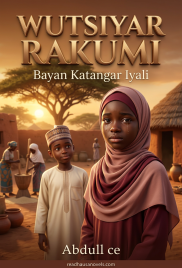
WUTSIYAR RAK'UMI Bayan Katangar Iyali | Complete Novel in Hausa
By Abdull ce
Novel Blurb
In a world where family is supposed to represent love, protection, and belonging, what happens when the very people who should protect a child become the source of her deepest suffering? What becomes of a young girl whose childhood is shaped not by the warmth of a mother's embrace, but by rejection, cruelty, endless responsibilities, and the painful realisation that being part of a family does not necessarily mean being loved by everyone in it? For Ummukulsoom, these are not distant questions or stories she has heard from others. They are the realities of a life she never chose, a childhood marked by loss, and a struggle to find happiness in a home where her presence seems to inconvenience almost everyone.
WUTSIYAR RAƘUMI (Tai Nesa da Ƙasa) by Bilyn Abdull is an emotionally engaging Hausa novel that takes readers into the heart of a traditional Northern Nigerian household, where family relationships, cultural expectations, jealousy, childhood innocence, and the struggle for a better future come together in a deeply human story. Set against the backdrop of Ɗilau, a village whose communal lifestyle reflects the richness and complexity of traditional Hausa society, the novel introduces a world in which several generations live under one roof, sharing responsibilities, traditions, disagreements, and the complicated relationships that come with an extended family. Beneath the lively atmosphere of the household, however, lies a painful reality that not everyone experiences the same kind of love, consideration, or opportunity.
The story opens in a remarkably vivid manner, taking readers directly into the daily life of BABBAN GIDA, a large family compound in Ɗilau. The sound of pounding mortars, women's laughter, playful teasing, and the rhythmic activities of preparing food create an atmosphere of movement and communal energy. Women gather in different groups, pounding grains, preparing meals for sale, tending to cooking fires, and exchanging stories beneath the shade of a tree. Children play around the compound while other family members attend to their various responsibilities. To an unfamiliar visitor, the gathering might easily be mistaken for a wedding celebration or a special occasion. Yet this is simply an ordinary day in a household whose population is so large that its daily activities resemble a small community.
The author uses this opening to establish more than the physical setting. It introduces readers to a social environment where family connections are extensive, where children, grandchildren, daughters-in-law, and other relatives share the same compound, and where individual lives are closely connected to the decisions and attitudes of others. In such a household, privacy is limited, opinions are plentiful, and a person's personal struggles can quickly become the subject of public discussion. It is a setting that offers both the comfort of belonging and the possibility of profound emotional isolation.
Among the people living in this enormous household is Malam Buhari, a hardworking man whose livelihood comes from traditional weaving. Known as Mai Kaba, he makes mats, traditional woven containers, and other handmade products, which he sometimes transports to Kaduna and Zaria to sell. Alongside his craft, he also engages in farming during the rainy season. His occupation reflects the resourcefulness of a man determined to provide for his family through honest labour, even when the responsibilities placed upon him are considerable.
Malam Buhari has three wives and ten children. His first wife, Yalwa, commonly addressed as Baba Yalwa, has five children, three sons and two daughters. His second wife, Ɗahara, had only one surviving child, Ummukulsoom, after experiencing the heartbreaking loss of several babies. Tragically, Ɗahara also died during childbirth, leaving her young daughter without the protection and affection of a mother. His youngest wife, Asabe, has four children, three daughters and one son.
These different branches of the family share one household, but their relationships are far from simple. Each wife has her own children, responsibilities, and interests, while the presence of several generations creates a complicated family structure in which affection, rivalry, favouritism, and resentment exist side by side. It is within this environment that Ummukulsoom's story begins to unfold.
Ummukulsoom is introduced as a child whose life is shaped by an early and devastating loss. She was only three years old when her mother died, too young to understand the full meaning of death but old enough to grow up feeling the absence of someone who should have been beside her. Her mother had endured repeated pregnancy losses before finally giving birth to Ummukulsoom, the one child who survived. The happiness surrounding her birth was eventually overshadowed by another pregnancy that ended in the death of both mother and unborn child.
The loss leaves Ummukulsoom without the one person who might have offered her unconditional protection within the complicated household. Her father, Malam Buhari, is left with the responsibility of raising her alongside his other children, but the demands of his work make it difficult for him to remain constantly at home. He therefore entrusts his daughter to the women of the household, particularly Baba Yalwa, believing that they will care for her as they would their own children.
Before her mother's death, Ummukulsoom had enjoyed the extraordinary affection of her grandmother, Innayo, the mother of Malam Buhari. Innayo's love for her granddaughter was so strong that she could hardly tolerate seeing the child unhappy. Whether Ummukulsoom needed something, got into trouble, or experienced mistreatment, she knew that her grandmother would listen. Innayo was not merely an elderly relative; she was the emotional centre of the little girl's world, a source of security in a family where her position was already different from that of the other children.
This special relationship, however, creates resentment among other members of the household. Innayo's affection for Ummukulsoom is interpreted by some of the other women as favouritism. They believe she gives the child more attention than she gives their own children, and their dissatisfaction gradually becomes another burden for the young girl. Even Malam Buhari sometimes attempts to persuade his mother to distribute her affection more evenly, but Innayo refuses to compromise the special bond she shares with her granddaughter.
For Ummukulsoom, the love of her grandmother makes the household feel like a place where she belongs. Unfortunately, that protection does not last forever.
When Innayo dies, Ummukulsoom is only nine years old. Her grandmother's passing marks one of the most painful turning points in her childhood. Although she is still young, she understands enough to recognise that the person who consistently defended her is gone. The loss is especially difficult because she has no mother to return to for comfort. The person who had filled that emotional space is now also absent.
There is something particularly heartbreaking about the way Ummukulsoom experiences this second loss. When she needs something, when she is punished unfairly, or when she simply wants someone to listen, she instinctively remembers the grandmother who used to answer her calls. Sometimes she enters the familiar room only to find it empty. In those moments, the reality of her loneliness becomes almost unbearable.
The absence of Innayo changes the way the household treats her. The women who had previously restrained their hostility because of the grandmother's presence no longer feel the same pressure to conceal their attitudes. The promises made to Malam Buhari when he entrusted them with his daughter gradually lose their meaning. Instead of receiving the care expected of a child who has lost her mother, Ummukulsoom becomes the target of neglect, excessive demands, and deliberate mistreatment.
Her situation becomes especially painful because the person responsible for providing for her is often away from home. Malam Buhari works hard to sustain his family, travelling to sell his woven products and tending to his farming responsibilities. His absence leaves his daughter dependent on people who do not necessarily have her best interests at heart.
The difference between Ummukulsoom and the other children becomes increasingly obvious. While some of them are allowed to play, rest, and enjoy their childhood, she is expected to perform household duties regardless of her age or physical condition. Tasks that should be shared among several children are frequently placed on her shoulders. When she complains or refuses, punishment follows. At times, even children younger than her are encouraged to discipline her.
The cruelty is not always expressed through physical violence. Sometimes it appears in the small but deeply hurtful ways people exclude a child from their affection. Ummukulsoom watches other children receive the attention and consideration she is denied. She sees how easily their mistakes are overlooked while hers attract criticism. She experiences the difference between being treated as someone's daughter and being treated as an unwanted responsibility.
Her circumstances reveal one of the central emotional realities explored in WUTSIYAR RAƘUMI: the painful distinction between biological family ties and genuine compassion. Sharing a father, a surname, or a household does not automatically create kindness. Sometimes, the people closest to a person are the ones who understand exactly where to inflict the deepest emotional wounds.
Yet Ummukulsoom is not entirely alone.
Among the few people who show genuine concern for her is Basiru, the son of their neighbours. His connection with Ummukulsoom begins when they are both very young. He is approximately five or six years older than she is, and their childhood relationship develops through innocent teasing, companionship, and the kind of simple affection that children often struggle to explain.
Basiru has a particular habit of teasing Ummukulsoom by calling her his girlfriend. At first, the adults and other children regard this as ordinary childhood play. Nobody attaches much importance to it because both children are still very young. However, as time passes, Basiru's behaviour reveals a level of attachment that goes beyond casual teasing.
Following the death of Innayo, Basiru becomes one of the few people who notices how difficult life has become for Ummukulsoom. When he finds her crying, he tries to comfort her. When she tells him that other children have beaten her, he sometimes intervenes and stands up for her. His willingness to defend her is not always welcomed by the other families. The parents of the children involved have repeatedly warned him to stay away from their children, but such warnings rarely change his determination to help Ummukulsoom when he believes she has been wronged.
For a girl who has grown accustomed to being blamed, ignored, and mistreated, Basiru's concern carries considerable emotional significance. He does not offer her the protection of a parent or the authority of an elder, but he gives her something she desperately needs: the reassurance that someone notices when she is hurting.
Their relationship also introduces a gentle romantic element into the narrative. Basiru is handsome, with an appearance that attracts attention among the young girls of the village. His Fulani heritage, inherited through his mother, contributes to his striking appearance, making him particularly admired by many of the girls around him. Yet while others admire him from a distance, Ummukulsoom's connection with him is built upon years of familiarity, childhood memories, and the emotional security he represents.
For Ummukulsoom, however, understanding these feelings is not simple. She is still young, and the affection she carries for Basiru exists alongside the uncertainties of growing up. She notices the attention he receives from other girls and sometimes feels uncomfortable about it, even if she cannot fully explain the emotions behind her reactions. What she understands is that Basiru occupies a special place in her life, one that is difficult to replace.
As the children grow older, their lives begin to move in different directions. Basiru completes primary school and joins other boys from the village who leave to attend secondary school. His departure represents an early change in their childhood relationship, although it does not erase the attachment that has developed between them.
Meanwhile, Ummukulsoom continues to endure the difficult conditions of her home. Her experiences are shaped by the daily hostility of some of her father's other children, particularly Nusaiba, Hadiza, and the other girls who find different ways to make her feel inferior. She often responds with silence and tears, although there are occasions when the accumulated frustration becomes too much and she fights back.
Even then, her attempts to defend herself rarely produce the outcome she hopes for. The other children have parents within the household who are ready to defend them, while Ummukulsoom often finds herself standing alone. A disagreement that might have been resolved fairly becomes another opportunity to punish her.
This unequal treatment gradually teaches her that being right does not always mean being believed. In a household where the children of different mothers are treated according to their individual family positions, the truth can become less important than whose side an adult chooses to support.
Despite these difficulties, Ummukulsoom's father remains an important source of happiness. Whenever Malam Buhari returns home, her mood changes. His presence offers temporary relief from the treatment she receives when he is away. The household may become more restrained in its behaviour towards her, and the young girl can enjoy moments of peace that are otherwise difficult to find.
Malam Buhari is not presented as a man without flaws or limitations. His position within a large household requires him to balance the demands of several wives and numerous children. Nevertheless, he demonstrates a determination to provide his children with opportunities that he believes can improve their lives.
One of the most significant expressions of this determination emerges when Ummukulsoom and the other girls complete their primary education.
In their community, continuing education beyond primary school is not a widely embraced expectation for girls. Many families prefer to arrange marriages for their daughters after primary school, while some do not even consider formal primary education necessary. The prevailing attitudes reflect a traditional understanding of women's futures, one in which marriage and domestic responsibilities frequently take precedence over academic ambitions.
Malam Buhari, however, begins to question this established pattern.
Through his occupation, he travels beyond Ɗilau to larger towns and cities, where he observes children attending school and sees the opportunities that education can provide. His experiences gradually strengthen his desire to give his own children a different future. He does not want them to remain limited by the same circumstances that have restricted many young people in their community.
Having watched his older daughters, Rabi and Zainaba, marry after completing primary school, he becomes increasingly concerned about the direction their lives have taken. Their struggles after marriage make him reflect on the importance of education, knowledge, and the ability to make informed decisions.
He therefore makes an unexpected announcement: Ummukulsoom, Azima, and Nusaiba will continue their education by attending secondary school.
For Ummukulsoom, the news is a source of immense happiness. It is not simply an opportunity to continue studying. It represents the possibility of a life that extends beyond the walls of the household where she has spent so many years feeling unwanted. It offers her a chance to learn, grow, and imagine a future in which her identity is not defined by the demands of other people.
The announcement is equally meaningful because it connects with something Basiru has always encouraged. Even before this development, he had repeatedly prayed that Ummukulsoom would be allowed to continue her education. He himself has a father who insists that he should not marry until he has advanced to university. His family believes that education should come before early marriage, an outlook that distinguishes them from many of the families around them.
When Ummukulsoom hears her father's decision, she is eager to share the news with Basiru. She runs to his house, excited by the possibility of continuing her studies. Basiru's happiness is equally obvious. His reaction shows how much he values the opportunity being given to her, and his excitement becomes a memorable moment of shared childhood happiness.
But not everyone welcomes the development.
The parents of Azima and Nusaiba are strongly opposed to the decision. They cannot understand why their daughters should spend additional years in school when they believe marriage is the more appropriate next step. They question Malam Buhari's decision and compare it with the choices other families in the village have made.
Their opposition is not merely a disagreement about school attendance. It exposes a deeper conflict between traditional expectations and the possibility of social change. Malam Buhari wants his children to acquire knowledge and have wider opportunities, while others fear that additional education may encourage their daughters to become independent or challenge established family expectations.
The disagreement becomes particularly serious because the girls' activities at home are also connected to the household economy. The young women help with various forms of trading and food preparation, and their contributions provide additional income for the family. Their attendance at secondary school means that they will no longer be available for the same daily responsibilities.
The women who benefit from their labour therefore have another reason to oppose the decision.
For years, Ummukulsoom has been expected to work even when she is exhausted. Her step-siblings, meanwhile, have often enjoyed greater freedom. The prospect of secondary education introduces a new dimension to this unequal arrangement. If the girls begin attending school, their time will become more limited, and the existing household responsibilities will have to be reconsidered.
The resistance from the other women does not discourage Malam Buhari. He recognises that his household cannot remain trapped in a pattern simply because other people have accepted it as normal. He refuses to abandon his decision and insists that his children deserve the chance to pursue their education.
Eventually, after considerable disagreement and unsuccessful attempts to change his mind, the opposing families have little choice but to accept the arrangement. The girls are enrolled in a day secondary school in Kudan, a town near Ɗilau.
This development marks a significant transition in the story. Ummukulsoom and her companions are moving beyond the familiar environment of their primary-school years and entering a stage of life that brings new expectations, experiences, and possibilities.
For Ummukulsoom, education becomes more than a classroom experience. It is an opportunity to discover her abilities and develop a future beyond the limitations imposed upon her by the household. It also represents a continuation of the encouragement she has received from Basiru, whose own educational journey has given him a broader understanding of what young people can achieve.
The contrast between these two households is particularly interesting. While Malam Buhari is beginning to recognise the importance of education for his daughters, Basiru's father has already established education as a priority for his son. Both families represent different attitudes towards the future, and their contrasting approaches provide an important social background to the developing relationship between the young characters.
At the heart of the novel is the experience of a girl growing up in circumstances that constantly test her emotional strength. Ummukulsoom is not born into poverty or completely abandoned by her father. She lives in a large family with people around her, and her basic needs are not entirely neglected. Yet her story demonstrates that material provision and emotional care are two very different things.
A child can have a roof over her head and food to eat while still experiencing profound loneliness. She can live among dozens of relatives and have nobody she feels safe enough to approach. She can share the same father with other children and still be made to feel that she does not deserve the same consideration they receive.
This emotional complexity gives the novel much of its appeal. Instead of presenting family life as an uncomplicated source of happiness, the author examines the tensions that can develop within polygamous households, particularly when children are treated differently because of their mothers' positions, relationships, or absence.
The death of Ummukulsoom's mother is especially important to understanding her circumstances. Her mother's absence creates a vulnerability that becomes more pronounced after Innayo's death. The grandmother had served as a protective figure, and losing her means losing the person who understood the child's emotional needs and was willing to defend her without hesitation.
The novel also explores the responsibilities of parenthood through Malam Buhari's character. His decision to work hard and provide for his family demonstrates his sense of responsibility, but his frequent absence reveals the difficulties of balancing economic provision with emotional supervision. His trust in the women of the household creates a situation in which his daughter experiences treatment that he might not fully witness.
This raises an important question about parental responsibility: is providing food, shelter, and education enough when a child is exposed to mistreatment in the very environment where she is expected to feel protected?
Through Ummukulsoom's experiences, readers are encouraged to consider the importance of paying attention to children's emotional well-being, listening when they report mistreatment, and ensuring that family responsibilities are not distributed unfairly.
Another significant aspect of the story is its treatment of education as a means of opening possibilities. The decision to send the girls to secondary school challenges an established pattern within the community. It highlights the difference between preserving cultural values and allowing outdated assumptions to prevent younger generations from accessing opportunities.
Malam Buhari's determination is particularly relevant because his own livelihood comes from traditional craftsmanship and farming. He understands the value of hard work, but he also recognises that his children should not necessarily inherit the same limitations. His experiences outside the village have shown him that education can broaden a person's understanding of the world and provide opportunities that might otherwise remain inaccessible.
The novel's portrayal of Ɗilau also contributes to its distinctive atmosphere. The compound, its cooking areas, the pounding mortars, the conversations among women, and the shared responsibilities create a recognisable picture of traditional Hausa communal life. These details give the narrative a strong cultural foundation, allowing readers to experience the environment rather than merely receive a description of it.
The presence of characters such as Baba Yalwa, Asabe, Ɗahara, Innayo, Malam Buhari, Basiru, and the younger children further establishes the household as a complex social world. Each relationship contributes to the circumstances surrounding Ummukulsoom, making her experiences inseparable from the wider family structure.
For readers who enjoy Hausa novels centred on family relationships, childhood experiences, traditional values, and emotional struggles, WUTSIYAR RAƘUMI offers an engaging narrative with considerable room for reflection. Its story combines domestic drama with themes of affection, jealousy, resilience, education, and the challenges of growing up in a large extended family.
Readers interested in Hausa romance will also find an appealing emotional thread in the relationship between Ummukulsoom and Basiru. Their connection begins during childhood, when affection is expressed through innocent teasing and acts of protection. What makes their bond interesting is the history behind it. Basiru is not simply a handsome young man admired by the girls of the village; he is someone who has witnessed Ummukulsoom's vulnerability and has repeatedly shown concern for her happiness.
Their relationship adds tenderness to a story otherwise shaped by difficult family experiences. It reminds readers that kindness can sometimes come from unexpected places and that a small act of compassion can become deeply meaningful to someone who has experienced repeated rejection.
Nevertheless, the novel's appeal extends beyond romance. Its strongest emotional foundation lies in the contrast between the home Ummukulsoom inhabits and the home she wishes she could experience. The large compound is filled with people, but the child at its centre often feels alone. The household is busy with work and conversation, yet her private pain remains largely unseen. She has a father who cares about her future, but the daily reality of her childhood is shaped by people whose treatment of her is far removed from his intentions.
This contrast gives the narrative a compelling emotional dimension and makes Ummukulsoom a character readers can become invested in. Her experiences invite sympathy, but they also encourage readers to recognise her developing strength. She is not simply a child who suffers; she is a young girl gradually learning to understand the people around her, recognise unfairness, and find moments of happiness despite the challenges she faces.
The title, WUTSIYAR RAƘUMI (Tai Nesa da Ƙasa), adds another layer of curiosity to the reading experience. It is an unusual and memorable expression that invites readers to consider its significance within the wider story. Its meaning and relevance become part of the intrigue surrounding the novel, encouraging readers to discover how the title connects with the characters and the experiences that shape their lives.
Bilyn Abdull builds the opening of this narrative around recognisable human experiences rather than relying solely on dramatic events. The result is a story whose emotional weight comes from everyday situations: a child returning home after fetching water, a grandmother whose absence leaves an empty space, a father struggling to provide for his family, a young boy defending someone he cares about, and a girl discovering that her future might hold possibilities beyond what she has always known.
These apparently ordinary moments give the novel its human quality. They allow readers to recognise how family relationships are formed, how resentment can develop, and how the smallest decisions can have lasting effects on a child's life.
WUTSIYAR RAƘUMI is therefore an interesting addition to contemporary Hausa literature, particularly for readers who appreciate stories that examine the realities of traditional family life while exploring the importance of education and personal development. It combines the familiar atmosphere of village life with the emotional concerns of a young protagonist whose circumstances are far more complicated than her age should require.
Whether you enjoy a compelling family drama, a heartfelt coming-of-age story, or a Hausa romance built around a longstanding childhood connection, this novel offers several reasons to become interested in its characters. Its exploration of parental responsibility, sibling rivalry, the experiences of motherless children, and the struggle to overcome restrictive expectations gives it an appeal that extends beyond simple entertainment.
For those searching for a captivating Hausa novel, a meaningful littafin Hausa, or an engaging story to add to their collection of littattafan Hausa, WUTSIYAR RAƘUMI deserves attention. It is a story that brings together family, affection, hardship, and the hope of a different future, while presenting a cultural setting that will feel familiar to many readers.
The most compelling question surrounding Ummukulsoom is not simply how she will endure the difficulties of her childhood, but what kind of future she can build when the people around her do not always make that journey easy. Will the opportunities her father is determined to provide become the beginning of a different life? How will her childhood connection with Basiru develop as they grow older and encounter new responsibilities? And what will happen as the different expectations, loyalties, and attitudes within the household continue to shape their lives?
These are some of the questions that make the complete novel worth discovering. The story invites readers to look beyond the noise and activity of BABBAN GIDA and pay attention to the young girl whose experiences reveal a very different side of family life.
"Sometimes, the greatest loneliness is not found in an empty house, but in a crowded home where a child's heart has nowhere to find shelter."
WUTSIYAR RAƘUMI (Tai Nesa da Ƙasa) by Bilyn Abdull is an invitation into a world of complicated family relationships, childhood innocence, emotional endurance, and the hope that life can become something better. It is a reminder that a person's childhood circumstances do not have to define the limits of their future, and that the smallest acts of love can make an extraordinary difference in a life that has known too much rejection.
Step into Ɗilau, experience the realities of BABBAN GIDA, and follow Ummukulsoom's journey as she grows up surrounded by relationships that will test her patience, challenge her understanding of love, and shape the possibilities of her future. Discover the complete story of WUTSIYAR RAƘUMI, a Hausa novel that brings the emotional realities of family life into focus and leaves readers with much to think about long after they have turned the final page.




















WUTSIYAR RAK'UMI Bayan Katangar Iyali | Complete Novel in Hausa
By Abdull ce
Novel Blurb
In a world where family is supposed to represent love, protection, and belonging, what happens when the very people who should protect a child become the source of her deepest suffering? What becomes of a young girl whose childhood is shaped not by the warmth of a mother's embrace, but by rejection, cruelty, endless responsibilities, and the painful realisation that being part of a family does not necessarily mean being loved by everyone in it? For Ummukulsoom, these are not distant questions or stories she has heard from others. They are the realities of a life she never chose, a childhood marked by loss, and a struggle to find happiness in a home where her presence seems to inconvenience almost everyone.
WUTSIYAR RAƘUMI (Tai Nesa da Ƙasa) by Bilyn Abdull is an emotionally engaging Hausa novel that takes readers into the heart of a traditional Northern Nigerian household, where family relationships, cultural expectations, jealousy, childhood innocence, and the struggle for a better future come together in a deeply human story. Set against the backdrop of Ɗilau, a village whose communal lifestyle reflects the richness and complexity of traditional Hausa society, the novel introduces a world in which several generations live under one roof, sharing responsibilities, traditions, disagreements, and the complicated relationships that come with an extended family. Beneath the lively atmosphere of the household, however, lies a painful reality that not everyone experiences the same kind of love, consideration, or opportunity.
The story opens in a remarkably vivid manner, taking readers directly into the daily life of BABBAN GIDA, a large family compound in Ɗilau. The sound of pounding mortars, women's laughter, playful teasing, and the rhythmic activities of preparing food create an atmosphere of movement and communal energy. Women gather in different groups, pounding grains, preparing meals for sale, tending to cooking fires, and exchanging stories beneath the shade of a tree. Children play around the compound while other family members attend to their various responsibilities. To an unfamiliar visitor, the gathering might easily be mistaken for a wedding celebration or a special occasion. Yet this is simply an ordinary day in a household whose population is so large that its daily activities resemble a small community.
The author uses this opening to establish more than the physical setting. It introduces readers to a social environment where family connections are extensive, where children, grandchildren, daughters-in-law, and other relatives share the same compound, and where individual lives are closely connected to the decisions and attitudes of others. In such a household, privacy is limited, opinions are plentiful, and a person's personal struggles can quickly become the subject of public discussion. It is a setting that offers both the comfort of belonging and the possibility of profound emotional isolation.
Among the people living in this enormous household is Malam Buhari, a hardworking man whose livelihood comes from traditional weaving. Known as Mai Kaba, he makes mats, traditional woven containers, and other handmade products, which he sometimes transports to Kaduna and Zaria to sell. Alongside his craft, he also engages in farming during the rainy season. His occupation reflects the resourcefulness of a man determined to provide for his family through honest labour, even when the responsibilities placed upon him are considerable.
Malam Buhari has three wives and ten children. His first wife, Yalwa, commonly addressed as Baba Yalwa, has five children, three sons and two daughters. His second wife, Ɗahara, had only one surviving child, Ummukulsoom, after experiencing the heartbreaking loss of several babies. Tragically, Ɗahara also died during childbirth, leaving her young daughter without the protection and affection of a mother. His youngest wife, Asabe, has four children, three daughters and one son.
These different branches of the family share one household, but their relationships are far from simple. Each wife has her own children, responsibilities, and interests, while the presence of several generations creates a complicated family structure in which affection, rivalry, favouritism, and resentment exist side by side. It is within this environment that Ummukulsoom's story begins to unfold.
Ummukulsoom is introduced as a child whose life is shaped by an early and devastating loss. She was only three years old when her mother died, too young to understand the full meaning of death but old enough to grow up feeling the absence of someone who should have been beside her. Her mother had endured repeated pregnancy losses before finally giving birth to Ummukulsoom, the one child who survived. The happiness surrounding her birth was eventually overshadowed by another pregnancy that ended in the death of both mother and unborn child.
The loss leaves Ummukulsoom without the one person who might have offered her unconditional protection within the complicated household. Her father, Malam Buhari, is left with the responsibility of raising her alongside his other children, but the demands of his work make it difficult for him to remain constantly at home. He therefore entrusts his daughter to the women of the household, particularly Baba Yalwa, believing that they will care for her as they would their own children.
Before her mother's death, Ummukulsoom had enjoyed the extraordinary affection of her grandmother, Innayo, the mother of Malam Buhari. Innayo's love for her granddaughter was so strong that she could hardly tolerate seeing the child unhappy. Whether Ummukulsoom needed something, got into trouble, or experienced mistreatment, she knew that her grandmother would listen. Innayo was not merely an elderly relative; she was the emotional centre of the little girl's world, a source of security in a family where her position was already different from that of the other children.
This special relationship, however, creates resentment among other members of the household. Innayo's affection for Ummukulsoom is interpreted by some of the other women as favouritism. They believe she gives the child more attention than she gives their own children, and their dissatisfaction gradually becomes another burden for the young girl. Even Malam Buhari sometimes attempts to persuade his mother to distribute her affection more evenly, but Innayo refuses to compromise the special bond she shares with her granddaughter.
For Ummukulsoom, the love of her grandmother makes the household feel like a place where she belongs. Unfortunately, that protection does not last forever.
When Innayo dies, Ummukulsoom is only nine years old. Her grandmother's passing marks one of the most painful turning points in her childhood. Although she is still young, she understands enough to recognise that the person who consistently defended her is gone. The loss is especially difficult because she has no mother to return to for comfort. The person who had filled that emotional space is now also absent.
There is something particularly heartbreaking about the way Ummukulsoom experiences this second loss. When she needs something, when she is punished unfairly, or when she simply wants someone to listen, she instinctively remembers the grandmother who used to answer her calls. Sometimes she enters the familiar room only to find it empty. In those moments, the reality of her loneliness becomes almost unbearable.
The absence of Innayo changes the way the household treats her. The women who had previously restrained their hostility because of the grandmother's presence no longer feel the same pressure to conceal their attitudes. The promises made to Malam Buhari when he entrusted them with his daughter gradually lose their meaning. Instead of receiving the care expected of a child who has lost her mother, Ummukulsoom becomes the target of neglect, excessive demands, and deliberate mistreatment.
Her situation becomes especially painful because the person responsible for providing for her is often away from home. Malam Buhari works hard to sustain his family, travelling to sell his woven products and tending to his farming responsibilities. His absence leaves his daughter dependent on people who do not necessarily have her best interests at heart.
The difference between Ummukulsoom and the other children becomes increasingly obvious. While some of them are allowed to play, rest, and enjoy their childhood, she is expected to perform household duties regardless of her age or physical condition. Tasks that should be shared among several children are frequently placed on her shoulders. When she complains or refuses, punishment follows. At times, even children younger than her are encouraged to discipline her.
The cruelty is not always expressed through physical violence. Sometimes it appears in the small but deeply hurtful ways people exclude a child from their affection. Ummukulsoom watches other children receive the attention and consideration she is denied. She sees how easily their mistakes are overlooked while hers attract criticism. She experiences the difference between being treated as someone's daughter and being treated as an unwanted responsibility.
Her circumstances reveal one of the central emotional realities explored in WUTSIYAR RAƘUMI: the painful distinction between biological family ties and genuine compassion. Sharing a father, a surname, or a household does not automatically create kindness. Sometimes, the people closest to a person are the ones who understand exactly where to inflict the deepest emotional wounds.
Yet Ummukulsoom is not entirely alone.
Among the few people who show genuine concern for her is Basiru, the son of their neighbours. His connection with Ummukulsoom begins when they are both very young. He is approximately five or six years older than she is, and their childhood relationship develops through innocent teasing, companionship, and the kind of simple affection that children often struggle to explain.
Basiru has a particular habit of teasing Ummukulsoom by calling her his girlfriend. At first, the adults and other children regard this as ordinary childhood play. Nobody attaches much importance to it because both children are still very young. However, as time passes, Basiru's behaviour reveals a level of attachment that goes beyond casual teasing.
Following the death of Innayo, Basiru becomes one of the few people who notices how difficult life has become for Ummukulsoom. When he finds her crying, he tries to comfort her. When she tells him that other children have beaten her, he sometimes intervenes and stands up for her. His willingness to defend her is not always welcomed by the other families. The parents of the children involved have repeatedly warned him to stay away from their children, but such warnings rarely change his determination to help Ummukulsoom when he believes she has been wronged.
For a girl who has grown accustomed to being blamed, ignored, and mistreated, Basiru's concern carries considerable emotional significance. He does not offer her the protection of a parent or the authority of an elder, but he gives her something she desperately needs: the reassurance that someone notices when she is hurting.
Their relationship also introduces a gentle romantic element into the narrative. Basiru is handsome, with an appearance that attracts attention among the young girls of the village. His Fulani heritage, inherited through his mother, contributes to his striking appearance, making him particularly admired by many of the girls around him. Yet while others admire him from a distance, Ummukulsoom's connection with him is built upon years of familiarity, childhood memories, and the emotional security he represents.
For Ummukulsoom, however, understanding these feelings is not simple. She is still young, and the affection she carries for Basiru exists alongside the uncertainties of growing up. She notices the attention he receives from other girls and sometimes feels uncomfortable about it, even if she cannot fully explain the emotions behind her reactions. What she understands is that Basiru occupies a special place in her life, one that is difficult to replace.
As the children grow older, their lives begin to move in different directions. Basiru completes primary school and joins other boys from the village who leave to attend secondary school. His departure represents an early change in their childhood relationship, although it does not erase the attachment that has developed between them.
Meanwhile, Ummukulsoom continues to endure the difficult conditions of her home. Her experiences are shaped by the daily hostility of some of her father's other children, particularly Nusaiba, Hadiza, and the other girls who find different ways to make her feel inferior. She often responds with silence and tears, although there are occasions when the accumulated frustration becomes too much and she fights back.
Even then, her attempts to defend herself rarely produce the outcome she hopes for. The other children have parents within the household who are ready to defend them, while Ummukulsoom often finds herself standing alone. A disagreement that might have been resolved fairly becomes another opportunity to punish her.
This unequal treatment gradually teaches her that being right does not always mean being believed. In a household where the children of different mothers are treated according to their individual family positions, the truth can become less important than whose side an adult chooses to support.
Despite these difficulties, Ummukulsoom's father remains an important source of happiness. Whenever Malam Buhari returns home, her mood changes. His presence offers temporary relief from the treatment she receives when he is away. The household may become more restrained in its behaviour towards her, and the young girl can enjoy moments of peace that are otherwise difficult to find.
Malam Buhari is not presented as a man without flaws or limitations. His position within a large household requires him to balance the demands of several wives and numerous children. Nevertheless, he demonstrates a determination to provide his children with opportunities that he believes can improve their lives.
One of the most significant expressions of this determination emerges when Ummukulsoom and the other girls complete their primary education.
In their community, continuing education beyond primary school is not a widely embraced expectation for girls. Many families prefer to arrange marriages for their daughters after primary school, while some do not even consider formal primary education necessary. The prevailing attitudes reflect a traditional understanding of women's futures, one in which marriage and domestic responsibilities frequently take precedence over academic ambitions.
Malam Buhari, however, begins to question this established pattern.
Through his occupation, he travels beyond Ɗilau to larger towns and cities, where he observes children attending school and sees the opportunities that education can provide. His experiences gradually strengthen his desire to give his own children a different future. He does not want them to remain limited by the same circumstances that have restricted many young people in their community.
Having watched his older daughters, Rabi and Zainaba, marry after completing primary school, he becomes increasingly concerned about the direction their lives have taken. Their struggles after marriage make him reflect on the importance of education, knowledge, and the ability to make informed decisions.
He therefore makes an unexpected announcement: Ummukulsoom, Azima, and Nusaiba will continue their education by attending secondary school.
For Ummukulsoom, the news is a source of immense happiness. It is not simply an opportunity to continue studying. It represents the possibility of a life that extends beyond the walls of the household where she has spent so many years feeling unwanted. It offers her a chance to learn, grow, and imagine a future in which her identity is not defined by the demands of other people.
The announcement is equally meaningful because it connects with something Basiru has always encouraged. Even before this development, he had repeatedly prayed that Ummukulsoom would be allowed to continue her education. He himself has a father who insists that he should not marry until he has advanced to university. His family believes that education should come before early marriage, an outlook that distinguishes them from many of the families around them.
When Ummukulsoom hears her father's decision, she is eager to share the news with Basiru. She runs to his house, excited by the possibility of continuing her studies. Basiru's happiness is equally obvious. His reaction shows how much he values the opportunity being given to her, and his excitement becomes a memorable moment of shared childhood happiness.
But not everyone welcomes the development.
The parents of Azima and Nusaiba are strongly opposed to the decision. They cannot understand why their daughters should spend additional years in school when they believe marriage is the more appropriate next step. They question Malam Buhari's decision and compare it with the choices other families in the village have made.
Their opposition is not merely a disagreement about school attendance. It exposes a deeper conflict between traditional expectations and the possibility of social change. Malam Buhari wants his children to acquire knowledge and have wider opportunities, while others fear that additional education may encourage their daughters to become independent or challenge established family expectations.
The disagreement becomes particularly serious because the girls' activities at home are also connected to the household economy. The young women help with various forms of trading and food preparation, and their contributions provide additional income for the family. Their attendance at secondary school means that they will no longer be available for the same daily responsibilities.
The women who benefit from their labour therefore have another reason to oppose the decision.
For years, Ummukulsoom has been expected to work even when she is exhausted. Her step-siblings, meanwhile, have often enjoyed greater freedom. The prospect of secondary education introduces a new dimension to this unequal arrangement. If the girls begin attending school, their time will become more limited, and the existing household responsibilities will have to be reconsidered.
The resistance from the other women does not discourage Malam Buhari. He recognises that his household cannot remain trapped in a pattern simply because other people have accepted it as normal. He refuses to abandon his decision and insists that his children deserve the chance to pursue their education.
Eventually, after considerable disagreement and unsuccessful attempts to change his mind, the opposing families have little choice but to accept the arrangement. The girls are enrolled in a day secondary school in Kudan, a town near Ɗilau.
This development marks a significant transition in the story. Ummukulsoom and her companions are moving beyond the familiar environment of their primary-school years and entering a stage of life that brings new expectations, experiences, and possibilities.
For Ummukulsoom, education becomes more than a classroom experience. It is an opportunity to discover her abilities and develop a future beyond the limitations imposed upon her by the household. It also represents a continuation of the encouragement she has received from Basiru, whose own educational journey has given him a broader understanding of what young people can achieve.
The contrast between these two households is particularly interesting. While Malam Buhari is beginning to recognise the importance of education for his daughters, Basiru's father has already established education as a priority for his son. Both families represent different attitudes towards the future, and their contrasting approaches provide an important social background to the developing relationship between the young characters.
At the heart of the novel is the experience of a girl growing up in circumstances that constantly test her emotional strength. Ummukulsoom is not born into poverty or completely abandoned by her father. She lives in a large family with people around her, and her basic needs are not entirely neglected. Yet her story demonstrates that material provision and emotional care are two very different things.
A child can have a roof over her head and food to eat while still experiencing profound loneliness. She can live among dozens of relatives and have nobody she feels safe enough to approach. She can share the same father with other children and still be made to feel that she does not deserve the same consideration they receive.
This emotional complexity gives the novel much of its appeal. Instead of presenting family life as an uncomplicated source of happiness, the author examines the tensions that can develop within polygamous households, particularly when children are treated differently because of their mothers' positions, relationships, or absence.
The death of Ummukulsoom's mother is especially important to understanding her circumstances. Her mother's absence creates a vulnerability that becomes more pronounced after Innayo's death. The grandmother had served as a protective figure, and losing her means losing the person who understood the child's emotional needs and was willing to defend her without hesitation.
The novel also explores the responsibilities of parenthood through Malam Buhari's character. His decision to work hard and provide for his family demonstrates his sense of responsibility, but his frequent absence reveals the difficulties of balancing economic provision with emotional supervision. His trust in the women of the household creates a situation in which his daughter experiences treatment that he might not fully witness.
This raises an important question about parental responsibility: is providing food, shelter, and education enough when a child is exposed to mistreatment in the very environment where she is expected to feel protected?
Through Ummukulsoom's experiences, readers are encouraged to consider the importance of paying attention to children's emotional well-being, listening when they report mistreatment, and ensuring that family responsibilities are not distributed unfairly.
Another significant aspect of the story is its treatment of education as a means of opening possibilities. The decision to send the girls to secondary school challenges an established pattern within the community. It highlights the difference between preserving cultural values and allowing outdated assumptions to prevent younger generations from accessing opportunities.
Malam Buhari's determination is particularly relevant because his own livelihood comes from traditional craftsmanship and farming. He understands the value of hard work, but he also recognises that his children should not necessarily inherit the same limitations. His experiences outside the village have shown him that education can broaden a person's understanding of the world and provide opportunities that might otherwise remain inaccessible.
The novel's portrayal of Ɗilau also contributes to its distinctive atmosphere. The compound, its cooking areas, the pounding mortars, the conversations among women, and the shared responsibilities create a recognisable picture of traditional Hausa communal life. These details give the narrative a strong cultural foundation, allowing readers to experience the environment rather than merely receive a description of it.
The presence of characters such as Baba Yalwa, Asabe, Ɗahara, Innayo, Malam Buhari, Basiru, and the younger children further establishes the household as a complex social world. Each relationship contributes to the circumstances surrounding Ummukulsoom, making her experiences inseparable from the wider family structure.
For readers who enjoy Hausa novels centred on family relationships, childhood experiences, traditional values, and emotional struggles, WUTSIYAR RAƘUMI offers an engaging narrative with considerable room for reflection. Its story combines domestic drama with themes of affection, jealousy, resilience, education, and the challenges of growing up in a large extended family.
Readers interested in Hausa romance will also find an appealing emotional thread in the relationship between Ummukulsoom and Basiru. Their connection begins during childhood, when affection is expressed through innocent teasing and acts of protection. What makes their bond interesting is the history behind it. Basiru is not simply a handsome young man admired by the girls of the village; he is someone who has witnessed Ummukulsoom's vulnerability and has repeatedly shown concern for her happiness.
Their relationship adds tenderness to a story otherwise shaped by difficult family experiences. It reminds readers that kindness can sometimes come from unexpected places and that a small act of compassion can become deeply meaningful to someone who has experienced repeated rejection.
Nevertheless, the novel's appeal extends beyond romance. Its strongest emotional foundation lies in the contrast between the home Ummukulsoom inhabits and the home she wishes she could experience. The large compound is filled with people, but the child at its centre often feels alone. The household is busy with work and conversation, yet her private pain remains largely unseen. She has a father who cares about her future, but the daily reality of her childhood is shaped by people whose treatment of her is far removed from his intentions.
This contrast gives the narrative a compelling emotional dimension and makes Ummukulsoom a character readers can become invested in. Her experiences invite sympathy, but they also encourage readers to recognise her developing strength. She is not simply a child who suffers; she is a young girl gradually learning to understand the people around her, recognise unfairness, and find moments of happiness despite the challenges she faces.
The title, WUTSIYAR RAƘUMI (Tai Nesa da Ƙasa), adds another layer of curiosity to the reading experience. It is an unusual and memorable expression that invites readers to consider its significance within the wider story. Its meaning and relevance become part of the intrigue surrounding the novel, encouraging readers to discover how the title connects with the characters and the experiences that shape their lives.
Bilyn Abdull builds the opening of this narrative around recognisable human experiences rather than relying solely on dramatic events. The result is a story whose emotional weight comes from everyday situations: a child returning home after fetching water, a grandmother whose absence leaves an empty space, a father struggling to provide for his family, a young boy defending someone he cares about, and a girl discovering that her future might hold possibilities beyond what she has always known.
These apparently ordinary moments give the novel its human quality. They allow readers to recognise how family relationships are formed, how resentment can develop, and how the smallest decisions can have lasting effects on a child's life.
WUTSIYAR RAƘUMI is therefore an interesting addition to contemporary Hausa literature, particularly for readers who appreciate stories that examine the realities of traditional family life while exploring the importance of education and personal development. It combines the familiar atmosphere of village life with the emotional concerns of a young protagonist whose circumstances are far more complicated than her age should require.
Whether you enjoy a compelling family drama, a heartfelt coming-of-age story, or a Hausa romance built around a longstanding childhood connection, this novel offers several reasons to become interested in its characters. Its exploration of parental responsibility, sibling rivalry, the experiences of motherless children, and the struggle to overcome restrictive expectations gives it an appeal that extends beyond simple entertainment.
For those searching for a captivating Hausa novel, a meaningful littafin Hausa, or an engaging story to add to their collection of littattafan Hausa, WUTSIYAR RAƘUMI deserves attention. It is a story that brings together family, affection, hardship, and the hope of a different future, while presenting a cultural setting that will feel familiar to many readers.
The most compelling question surrounding Ummukulsoom is not simply how she will endure the difficulties of her childhood, but what kind of future she can build when the people around her do not always make that journey easy. Will the opportunities her father is determined to provide become the beginning of a different life? How will her childhood connection with Basiru develop as they grow older and encounter new responsibilities? And what will happen as the different expectations, loyalties, and attitudes within the household continue to shape their lives?
These are some of the questions that make the complete novel worth discovering. The story invites readers to look beyond the noise and activity of BABBAN GIDA and pay attention to the young girl whose experiences reveal a very different side of family life.
"Sometimes, the greatest loneliness is not found in an empty house, but in a crowded home where a child's heart has nowhere to find shelter."
WUTSIYAR RAƘUMI (Tai Nesa da Ƙasa) by Bilyn Abdull is an invitation into a world of complicated family relationships, childhood innocence, emotional endurance, and the hope that life can become something better. It is a reminder that a person's childhood circumstances do not have to define the limits of their future, and that the smallest acts of love can make an extraordinary difference in a life that has known too much rejection.
Step into Ɗilau, experience the realities of BABBAN GIDA, and follow Ummukulsoom's journey as she grows up surrounded by relationships that will test her patience, challenge her understanding of love, and shape the possibilities of her future. Discover the complete story of WUTSIYAR RAƘUMI, a Hausa novel that brings the emotional realities of family life into focus and leaves readers with much to think about long after they have turned the final page.